- The Real Problem: Misaligned LOD Expectations in US Projects
- The Solution: Structured LOD Planning Based on US BIM Standards
- Understanding BIM LOD 100 to 500
- Why LOD Directly Impacts Construction Cost
- Choosing the Right LOD for Your Project
- Cost-Effective Strategy for US AEC Firms
- How a Strong BIM LOD Guide Strengthens Project Delivery
- Optimize Your BIM LOD Delivery for Smarter Project Outcomes
- FAQs
In 2026, US construction projects are moving faster, contracts are tighter, and risk tolerance is lower than ever. Yet many AEC firms still struggle with unclear modeling expectations. Teams begin with assumptions, consultants interpret model details differently, and contractors expect fabrication-ready information long before it exists.
At the center of this confusion lies one concept: BIM LOD.
When the BIM level of development is not clearly defined, coordination breaks down. As a result:
- Models are overdeveloped too early, increasing design fees
- Fabrication teams receive incomplete information
- Rework becomes common during construction
- Budget forecasting becomes unreliable
- Clients question data reliability
Therefore, understanding the levels of development in BIM is no longer optional for US AEC firms. It is a strategic necessity.
This comprehensive BIM LOD guide for AEC firms explains what LOD 100 to 500 truly means, how it affects coordination and cost, and how to define the right LOD requirements in construction projects aligned with US BIM standards.
The Real Problem: Misaligned LOD Expectations in US Projects
Across the United States, AEC teams operate under increasingly strict documentation standards. Public and federal projects require structured deliverables, while private developers demand precise digital coordination, often guided by experienced BIM Consulting Services.
However, many firms still confuse:
- Level of Detail (graphical richness)
- Level of Development (data reliability and responsibility)
This misunderstanding directly impacts the impact of LOD on construction cost. For example:
- Modeling at LOD 400 during schematic design wastes resources
- Delivering LOD 200 models for coordination creates clash risks
- Undefined BIM execution plan LOD requirements lead to disputes
In short, when BIM LOD levels are not clearly documented in the BIM Execution Plan (BEP), scope creep and cost escalation follow.
The Solution: Structured LOD Planning Based on US BIM Standards
To eliminate confusion, AEC firms must approach LOD strategically.
A well-structured BIM LOD guide for AEC firms should include:
- Clear LOD matrix per discipline
- Defined LOD requirements in construction projects by project phase
- Alignment with US BIM standards and contract language
- Defined a responsibility matrix in the BIM execution plan
- Documentation of model progression
When properly structured, the BIM level of development becomes a tool for risk control rather than a source of conflict.
Moreover, defining BIM execution plan LOD requirements early ensures that architects, engineers, contractors, and BIM consultants work with aligned expectations.
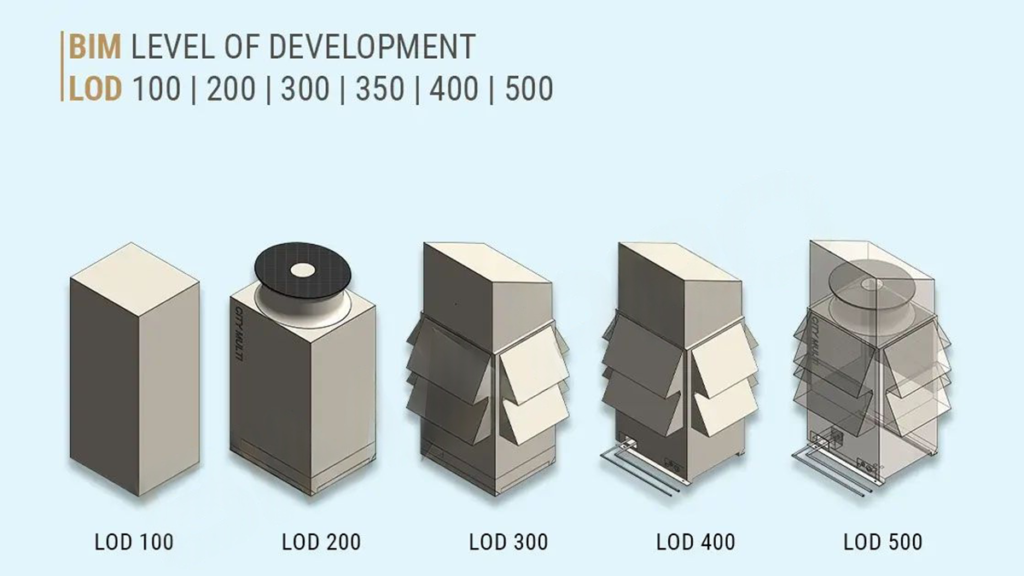
Understanding BIM LOD 100 to 500
The BIM LOD levels represent increasing reliability and usability of model elements. Below is a breakdown of the levels of development in BIM from conceptual design to facility management.
LOD 100 – Conceptual Representation
At LOD 100, model elements are symbolic. Geometry represents approximate size, shape, and location.
Typical use cases:
- Feasibility studies
- Concept validation
- Massing analysis
- Early cost estimation
However, using LOD 100 for coordination is risky. The LOD requirements in construction projects at this stage are limited to high-level design intent.
When misused, early overdevelopment increases modeling hours unnecessarily and affects the overall impact of LOD on construction cost.
LOD 200 – Approximate Geometry
LOD 200 introduces generic systems and approximate quantities. While still not fabrication-ready, it allows preliminary coordination when supported by structured BIM Modeling Services.
Common applications:
- Schematic design documentation
- Basic clash detection
- Early trade coordination
Yet, confusion between LOD 200 and LOD 300 often creates disputes. Therefore, documenting BIM execution plan LOD requirements at this stage is essential.
LOD 300 – Accurate Geometry for Construction Documentation
LOD 300 represents precise geometry and accurate quantities. Elements are located correctly and contain sufficient data for documentation.
Key benefits:
- Reliable quantity take-offs
- Detailed coordination
- Improved constructability review
- Better schedule alignment
Understanding BIM LOD 300 vs LOD 400 is critical here. LOD 300 supports construction documentation but does not include fabrication-level detailing.
For many US AEC firms, LOD 300 is the standard requirement for permit and contract documentation under US BIM standards.
LOD 400 – Fabrication and Installation Level
LOD 400 includes fabrication, assembly, and installation information. Trade contractors often develop this level.
Applications include:
- Shop drawings
- Prefabrication modeling
- Detailed MEP coordination
- Field-ready documentation
The difference in BIM LOD 300 vs LOD 400 directly affects scheduling and procurement. Modeling at LOD 400 too early increases design cost. However, delaying it too long creates site conflicts.
Thus, understanding the impact of LOD on construction cost becomes critical at this stage.
LOD 500 – As-Built and Facility Management
LOD 500 reflects field-verified conditions and supports long-term operations and facility management through accurate Scan to BIM Services.
Common uses:
- Asset management systems
- Maintenance scheduling
- Renovation planning
- Lifecycle cost analysis
Properly defined LOD requirements in construction projects ensure that as-built models truly represent field conditions rather than theoretical documentation.
Why LOD Directly Impacts Construction Cost
The impact of LOD on construction cost is often underestimated.
Consider the following scenarios:
- Overmodeling increases design fees
- Undermodeling causes rework
- Poor LOD planning delays procurement
- Incomplete data disrupts prefabrication
When AEC firms align BIM execution plan LOD requirements with project phases, cost control improves significantly.
Additionally, firms that use structured workflows and digital collaboration tools such as:
- Autodesk Revit
- Navisworks
- Autodesk Construction Cloud
can manage BIM LOD levels more effectively across distributed teams
Choosing the Right LOD for Your Project
Every project does not require LOD 500 across all disciplines. Instead, firms should base decisions on scope, contract stage, and intended use of the model, often supported by accurate Revit BIM Modeling workflows.
- Define the LOD matrix per trade
- Align the modeling scope with the contract stage
- Document BIM execution plan LOD requirements clearly
- Evaluate the real impact of LOD on construction cost before increasing the detail
For example:
- Core and shell projects may require LOD 300 for architectural elements
- MEP-heavy healthcare facilities may demand LOD 400
- Federal projects often define strict LOD requirements in construction projects
Strategic planning reduces modeling waste and improves efficiency.
Cost-Effective Strategy for US AEC Firms
In 2026, labor shortages and increasing project complexity push firms to explore smarter delivery models. Many US firms now rely on cost-effective BIM LOD services USA to balance quality and budget.
When properly structured, cost-effective BIM LOD services USA provide:
- Scalable modeling resources
- Discipline-specific LOD expertise
- Reduced overhead
- Faster turnaround times
- Compliance with US BIM standards
A structured BIM LOD guide for AEC firms helps define expectations before engaging external teams.
How a Strong BIM LOD Guide Strengthens Project Delivery
A well-prepared BIM LOD guide for AEC firms ensures:
- Alignment between stakeholders
- Controlled documentation growth
- Reduced RFIs
- Improved clash detection
- Clear accountability
Furthermore, defining levels of development in BIM within contracts protects firms from scope disputes.
When properly implemented, structured BIM LOD levels improve digital workflow maturity across AEC organizations.
Optimize Your BIM LOD Delivery for Smarter Project Outcomes
At Outsource BIM Services US, we bring 29+ years of group experience supporting AEC firms across the USA with structured, standards-driven BIM delivery aligned with US BIM Standards and clearly defined BIM LOD levels.
If your firm is refining its BIM LOD guide for AEC firms, defining precise LOD requirements in construction projects, or evaluating cost-effective BIM LOD services USA, our team is ready to support your projects with clarity, control, and measurable accuracy.
Let’s discuss how the right BIM LOD strategy can strengthen your coordination, reduce risk, and improve project cost performance in 2026.
FAQs
BIM LOD defines the reliability and development stage of model elements. For US AEC firms, clear BIM LOD planning prevents disputes, improves coordination, and aligns deliverables with US BIM standards.
BIM LOD 300 provides accurate geometry for construction documentation, while LOD 400 includes fabrication and installation details. Choosing between BIM LOD 300 vs LOD 400 depends on the project phase and trade responsibility.
Clearly defined LOD requirements in construction projects reduce scope confusion. When integrated into the BIM execution plan LOD requirements, they protect firms from rework and unexpected modeling obligations.
The impact of LOD on construction cost is significant. Over-modeling increases design expenses, while under-modeling causes site conflicts. Balanced BIM LOD planning improves cost predictability.
When aligned with US BIM standards and structured BIM execution plan LOD requirements, cost-effective BIM LOD services USA can deliver high-quality modeling while reducing operational overhead.
Get Your Instant Quote